

La ciencia en los medios
-
How Big Can Schrödinger’s Kittens Get?
Scientists are slowly scaling up quantum effects from atomic to human size.
-

48 Million Year-Old Horse Fetus Helps to Trace Evolution of Species
The reproductive system of horses has barely changed at all over the last 48 million years, according to a new study which analyzed the oldest-known fossil of a fetus belonging to a distant horse ancestor.
-

Bedtime problems boost kids’ math performance
Yet if a school child’s parents replace a bedtime story with a math discussion even one night a week, the child’s math skill may improve markedly compared with peers who listen to nonmathematical stories, a new study shows.
-

Insólitas ondas recorren un disco de formación de planetas
Los astrónomos han descubierto lo nunca visto en el disco de polvo que rodea una estrella: unas gigantescas y extrañas ondas, parecidas a las que se forman en el agua, que se alejan del astro a velocidades de hasta 40.000 km/h. Este curioso fenómeno sucede en el entorno de la estrella AU Microscopii, a ‘solo’…
-

Afrika, migrazioen sorburu ez ezik, hartzaile ere izan dela frogatu dute
Duela 3.000 urte eurasiatik Afrika ekialdera migrazio handi bat izan zela ondorioztatu dute, 4.500 urteko Etiopiako fosil baten genoma aztertuta, eta Europako, Ekialde Hurbileko eta Afrikako gaur egungo populazioen genomekin alderatuta. Nazioarteko talde batek egin du ikerketa, eta emaitzak Science aldizkarian argitaratu dituzte.
-

Newly Discovered Tablets Reveal Lost Lines From The Epic Of Gilgamesh
A newly retrieved clay tablet containing 20 unknown lines depicting the story of Gilgamesh has been discovered. The story of Gilgamesh is considered as the world’s oldest epic poem and literature’s first masterpiece.
-
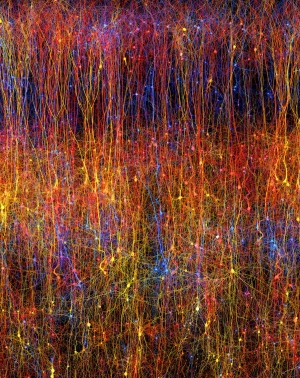
Fragment of rat brain simulated in supercomputer
A controversial European neuroscience project that aims to simulate the human brain in a supercomputer has published its first major result: a digital imitation of circuitry in a sandgrain-sized chunk of rat brain. The work models some 31,000 virtual brain cells connected by roughly 37 million synapses.
-

Mass Killings Are Seen as a Kind of Contagion
Experts have come to understand mass shootings less as isolated expressions of rage and more as acts that build on the outlines of previous rampages.
-
Una nueva especie, cero cadáveres
La primera descripción de un insecto sin necesidad de presentar el espécimen reabre un viejo debate: ¿no deberían bastar fotos en alta definición para clasificar nuevas especies?
Got any book recommendations?